
What to Know About Charitable Trusts in Estate Planning

Every successful business owner eventually crosses a threshold most spend little time preparing for: the shift from growing wealth to protecting it. In the early years, every decision is measured by growth — revenue, valuation, market share. But once real wealth is built, the math changes. A significant, unplanned tax event can undo decades of disciplined growth in a single transaction. For families and entrepreneurs standing at that threshold, charitable trusts are one of the most powerful tools available: a way to reduce tax exposure, generate income, and build a lasting philanthropic legacy, all within a single structure. This guide walks through how these trusts work, the tax mechanics that make them so effective, and how to know if one fits your financial roadmap.
Understanding Charitable Trusts and Split-Interest Vehicles
A charitable trust is an irrevocable legal arrangement that removes assets from your personal estate and places them under the control of a trustee, with a qualified charity named as a beneficiary. That single act — moving assets permanently outside your legal ownership — is what triggers preferential tax treatment. The IRS doesn’t reward intent to give; it rewards an irrevocable, legally enforceable transfer. Three parties interact over the life of the trust: the grantor, who funds it and sets its terms; the trustee, who manages the assets and administers distributions; and the charitable beneficiary, who ultimately receives what remains. Because the structure splits the benefit of the assets between a non-charitable party and a charity, these are often called split-interest trusts.
Charitable Remainder Trusts (CRTs)
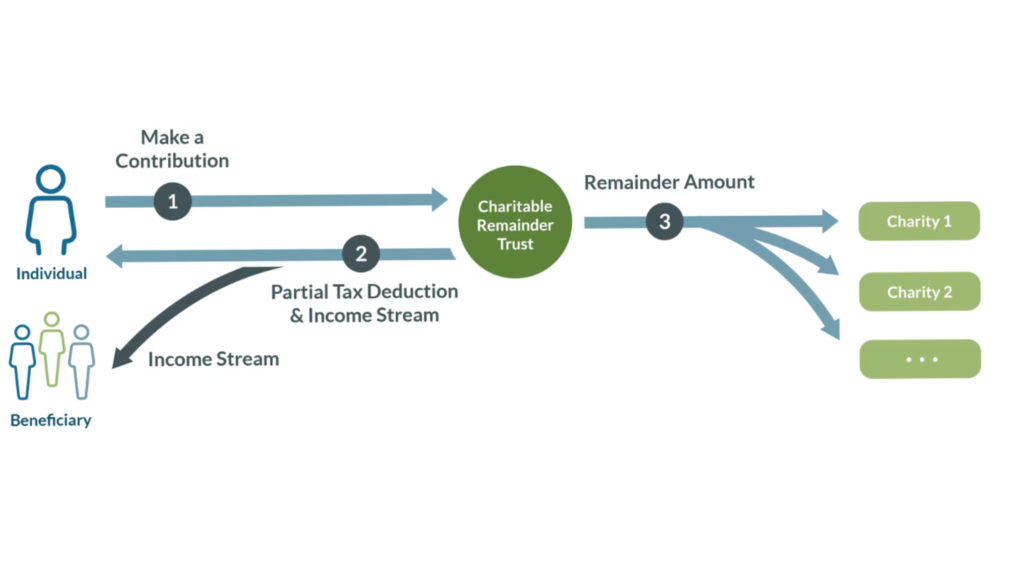
A Charitable Remainder Trust (CRT) is the more common of the two primary structures, and it’s built for donors who still need income from the assets they’re giving away. The mechanics are straightforward: you transfer appreciated assets into the trust, the trustee invests them, and the trust pays income back to you or your family for a set term or for life. When that term ends, whatever remains in the trust passes to the charity you named at the outset.
The IRS imposes strict payout limits. Under official IRS guidance on charitable remainder trusts, the annual distribution must be at least 5% of the trust’s assets but cannot exceed 50%, and the trust must be structured so that the charity is projected to receive at least 10% of the initial value contributed. These aren’t suggestions — a CRT that fails either test won’t qualify for the tax benefits that make the strategy worthwhile in the first place.
Deep Dive: CRUTs vs. CRATs
Within the CRT category, the choice comes down to a Charitable Remainder Unitrust (CRUT) or a Charitable Remainder Annuity Trust (CRAT). A CRUT revalues its assets every year and pays out a fixed percentage of that current value, which means the income stream can rise in strong markets and fall in weak ones — and it allows for additional contributions over time, giving donors flexibility to keep funding the trust as circumstances change. A CRAT, by contrast, locks in a fixed dollar payment at inception based on the trust’s initial value, and that amount never changes for the life of the trust. No further contributions are permitted. Retirees who prioritize absolute income certainty over growth potential tend to favor the CRAT; those comfortable with some variability, in exchange for inflation protection and funding flexibility, lean toward the CRUT.
Charitable Lead Trusts (CLTs)
A Charitable Lead Trust (CLT) inverts the CRT structure entirely. Instead of the family receiving income first and the charity receiving the remainder, the charity is paid an income stream for the trust’s term, and whatever remains afterward passes to the family. According to recent analysis from The Tax Adviser, the value of that future family gift is calculated and locked in using the IRS’s Section 7520 rate at the time the trust is funded — which is what makes CLTs an exceptional multi-generational tool. The excess growth may pass to children or grandchildren with potentially reduced gift tax consequences, depending on the trust structure, valuation methodology, and other factors affecting the CLT’s tax treatment. For families who already plan to give significantly to charity and want to pass along rapidly appreciating assets, a CLT can accomplish both goals inside one structure.
The Tax Architecture of Advanced Philanthropic Planning
Beyond the goodwill of giving, these trusts function as cornerstone strategies for wealth managers because the tax incentives are structural, not incidental. Understanding the mechanics is what separates a good outcome from a costly mistake.
Capital Gains Tax Mitigation on Appreciated Assets
Selling a highly appreciated stock position or investment real estate before funding a trust is one of the most common and expensive errors a high-net-worth investor can make. Selling first triggers capital gains tax immediately, on full appreciation, before a single dollar reaches the trust. In certain circumstances, transferring a low-basis asset directly to an irrevocable trust prior to a sale may help mitigate certain tax considerations, depending on the trust structure and the investor’s individual circumstances. The trustee may have flexibility to manage the asset within the trust, which could provide planning opportunities not available if the asset is sold before the trust is funded. The full, untaxed value goes to work generating income and growth from day one.
Upfront Income Tax Deductions and Direct Estate Reductions
Funding a CRT or CLT may also generate an immediate, partial income tax deduction in the year of contribution, depending on applicable tax rules and the donor’s individual circumstances. The IRS calculates that deduction based on the present value of the gift that will eventually reach the charity — a calculation that accounts for the trust’s term, the payout rate, and the applicable Section 7520 rate. Just as importantly, moving concentrated, volatile, or illiquid wealth out of your legal name permanently shrinks your taxable estate, reducing exposure to federal and, in many states, state estate tax thresholds. For families with significant wealth tied up in a single concentrated stock position or a closely held business, that estate tax reduction is often as valuable as the income tax deduction itself.
Strategic Evaluation: Aligning Trusts with Your Financial Roadmap
Not every philanthropically minded family needs a trust. The right first step is an honest audit of your timeline, liquidity needs, and appetite for complexity.
Charitable Trusts vs. Donor-Advised Funds (DAFs)
Both charitable trusts and donor-advised funds offer meaningful tax optimization, but they solve different problems. A trust offers granular control over payout structure, asset selection, and the timing of both income and the ultimate charitable gift — at the cost of higher setup complexity and legal fees, and the fact that it’s irrevocable from day one. A DAF is simpler and less expensive to administer, but it doesn’t provide a personal income stream. In practice, the two are often paired: naming a donor-advised fund as the ultimate charitable beneficiary of a CRT gives a family lifetime income now, plus the flexibility to decide which specific charities receive support later, without having to name every recipient organization at the outset.
Asset Optimization: What to Place Inside the Trust
Not every asset belongs in a charitable trust. The structures work best with highly appreciated, income-producing assets: concentrated public equities, pre-sale private company stock, or commercial real estate with significant embedded gains. These are exactly the assets where the capital gains deferral delivers the most value. There are hidden traps to watch for, though. S-corporation stock, for example, cannot typically be held by a CRT without jeopardizing the S-corp election entirely, and certain debt-encumbered real estate can trigger unrelated business taxable income inside the trust. Getting this wrong doesn’t just reduce the benefit — it can disqualify the structure altogether, which is why asset selection should never happen in isolation from legal and tax counsel.
Protecting What Matters Most
At The Wealth Stewards, we believe wealth is deeply personal, and legacy is about human impact, not just spreadsheets. Charitable trusts can be extraordinarily effective tools, but they are also legally unyielding once signed — there is no undoing an irrevocable trust because a family’s circumstances changed. That permanence is exactly why it’s critical to build a cohesive team, composed of your wealth manager, estate attorney, and CPA, before moving forward. Whether you’re evaluating a charitable trust alongside a plan to transition your business with intention, or simply looking to reduce estate tax exposure on assets you’ve spent a lifetime building, our team approaches every plan through a fiduciary relationship built around your unique values. If you’d like to explore whether a charitable trust fits your financial roadmap, speak with a wealth advisor about your goals before any decisions are finalized.
The information provided is for educational and informational purposes only. Concurrent Investment Advisors, LLC, d/b/a The Wealth Stewards, does not provide legal or tax advice. Please consult with your attorney, accountant, or tax advisor based on your individual circumstances.